
PoE Clocks
Power the clock and connect it to the network through one Ethernet cable. HC Electronics PoE clocks combine digital time displays with Ethernet-powered operation, removing the need for a separate power outlet at the clock position when connected to a compatible PoE supply.
Select a PoE-enabled display that fits your mounting location and matches the power equipment you plan to use. Request the electrical and mechanical specifications for the proposed clock configuration before confirming your order.
Digital Displays with Ethernet Power
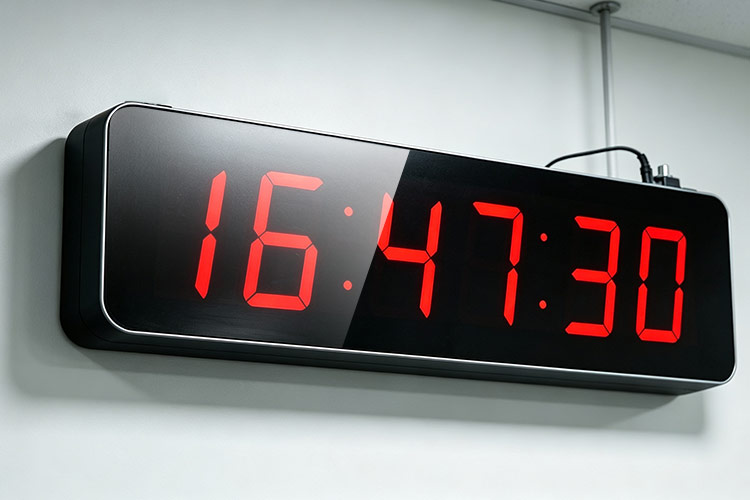
HC Electronics offers digital clock configurations with different display dimensions, 12- or 24-hour time formats, and wall-mounted or suspended mounting arrangements. The available combination should be confirmed for the selected PoE version.
For a PoE digital clock enquiry, specify the display information you need: hours and minutes, a seconds display, or additional date information. Include your preferred digit height and available mounting space so the proposed display can be reviewed together with its power requirements.
Match the Clock to Your PoE Equipment
A suitable PoE switch or injector supplies the clock’s operating power through the Ethernet cable. Compatibility depends on the supported power standard and the power available to the device—not simply whether both pieces of equipment have an Ethernet connector.
Send the manufacturer and model of your intended switch or injector with your enquiry. Include any required PoE standard, such as IEEE 802.3af or IEEE 802.3at, so the proposed clock can be checked against that requirement. Support must be confirmed for the specific clock version.
Request the clock’s maximum power consumption as well as its normal operating consumption. Where start-up demand or a particular display setting affects the power requirement, ask for that condition to be identified in the product information.
PoE Clock Specifications to Review
Use the model-specific specification to establish exactly what is being supplied. The following details should be checked for the clock under consideration.
| Product Detail | Information to Confirm |
|---|---|
| PoE input | Supported power standard, input requirements and powered-device classification where applicable. |
| Power consumption | Normal and maximum operating demand, with the relevant display settings and test conditions. |
| Ethernet connection | Port specification, connector position and cable requirements. |
| Time reception | Supported network timing method and compatibility with the intended time service. |
| Display configuration | Digit height, time format, seconds or date display, and available brightness settings. |
| Mechanical dimensions | Enclosure width, height, depth and weight for the selected version. |
| Mounting hardware | Bracket arrangement, fixing dimensions and accessories included with the clock. |
| Operating conditions | Permitted environmental conditions and any documented enclosure protection rating. |
For procurement documents, identify the model together with its display, power and mounting configuration. This avoids treating different versions of the same clock design as electrically or mechanically identical.
Mounting and Cable Clearance
A PoE wall clock needs space for both the enclosure and the Ethernet connection. Review the rear or side connector position, cable bend clearance and bracket depth against the proposed mounting surface.
For a suspended clock, request the drawing for the complete assembly, including the support arrangement and cable entry. For a two-sided display requirement, confirm the number of powered connections and the electrical rating of the proposed assembly.
Ask for mounting accessories to be identified in the quotation. A bracket supplied with the clock and fixings selected for the building surface should be distinguished clearly, so the installation team knows which items still need to be provided.
Confirm What Is Included
Make the supply scope clear when requesting a price. Specify whether you need the PoE clock alone or want an injector, network cable or other accessory quoted separately.
The order description should identify the exact clock configuration and included mounting hardware. Additional equipment should be listed individually rather than assumed to be part of the clock package.
For replacement purchases, include the existing unit’s label and a photo of its power connection. Ask for the replacement clock’s input specification and mounting drawing to be checked against the equipment being removed.
PoE Clock Purchasing Questions
Will an ordinary Ethernet socket power the clock?
Not necessarily. The socket must be connected to suitable PoE power-sourcing equipment. A data connection alone does not establish that operating power is available. Confirm the supply feeding the socket as well as the clock’s input requirements.
Can I use an existing passive PoE adapter?
Do not assume it is compatible. Standard PoE equipment and non-standard power arrangements may require different matching conditions. Provide the adapter model, output details and connection information for review before using it with the proposed clock.
Does PoE mean the clock will continue displaying time during a power failure?
No. PoE is a power-delivery method, not a battery-backup feature. Continued operation requires an available power source, such as suitably backed-up PoE equipment. Any internal backup capability—and whether it preserves timekeeping or powers the visible display—must be confirmed separately for the clock model.
Request a PoE Clock Quotation
Contact HC Electronics with your required quantity, preferred display configuration and mounting arrangement. Include the model of your PoE switch or injector, or the power standard your purchasing specification requires.
Request a quotation for the matching PoE clock version, with its electrical requirements, dimensions and included accessories clearly identified.
Request a PoE Clock Quote