A Healthcare Clock System for Peru
One master clock and 19 analog slave clocks. A proposed NTP configuration for a healthcare center that needs a shared time reference across its clock displays.
Technical data sheets for both models / 3 pages per language
Project scope: customer requirement and proposed equipment configuration.

- 1
- NTS-G-427001 master
- 19
- QS0020-1 analog clocks
- 400 mm
- Overall clock diameter
- NTP / SNTP
- Network synchronization
One reference for nineteen analog displays
A healthcare center in Peru requires one master clock and 19 analog slave clocks. The receiving clocks need to retain a traditional dial with hour, minute and second hands while following a common time source.
HC Electronics' proposed package pairs an NTS-G-427001 network time server with nineteen QS0020-1 clocks. The master provides NTP time through the local network, and each clock receives that time through its RJ45 connection.
Two models for the one-master, 19-clock package
The central timing source and the receiving displays form one defined equipment package.
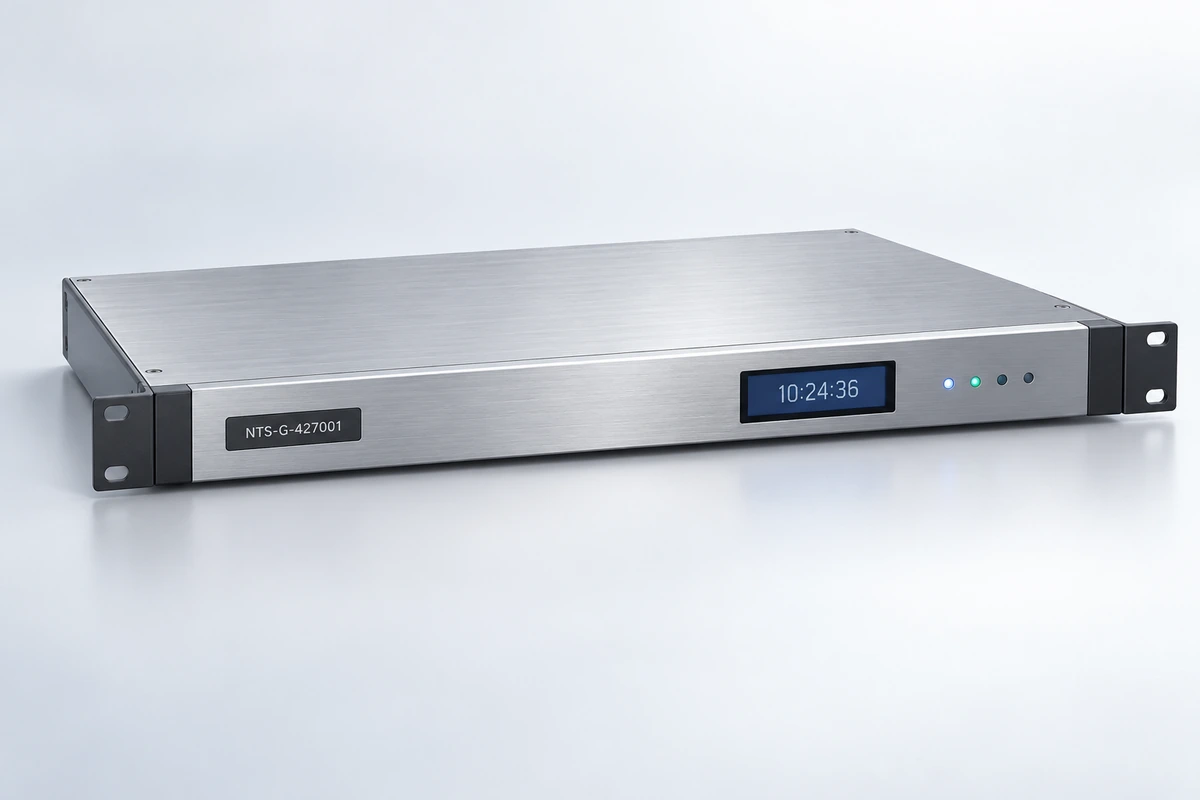
NTS-G-427001
A 1U time server assigned the master-clock role for the 19 receiving displays. The reference input and antenna arrangement would be confirmed for the site.
- Time distributionNTP and SNTP
- Network interfaces7 x Gigabit Ethernet
- Reference inputsGPS/BDS; 4G/5G option
- ManagementRemote configuration and logs
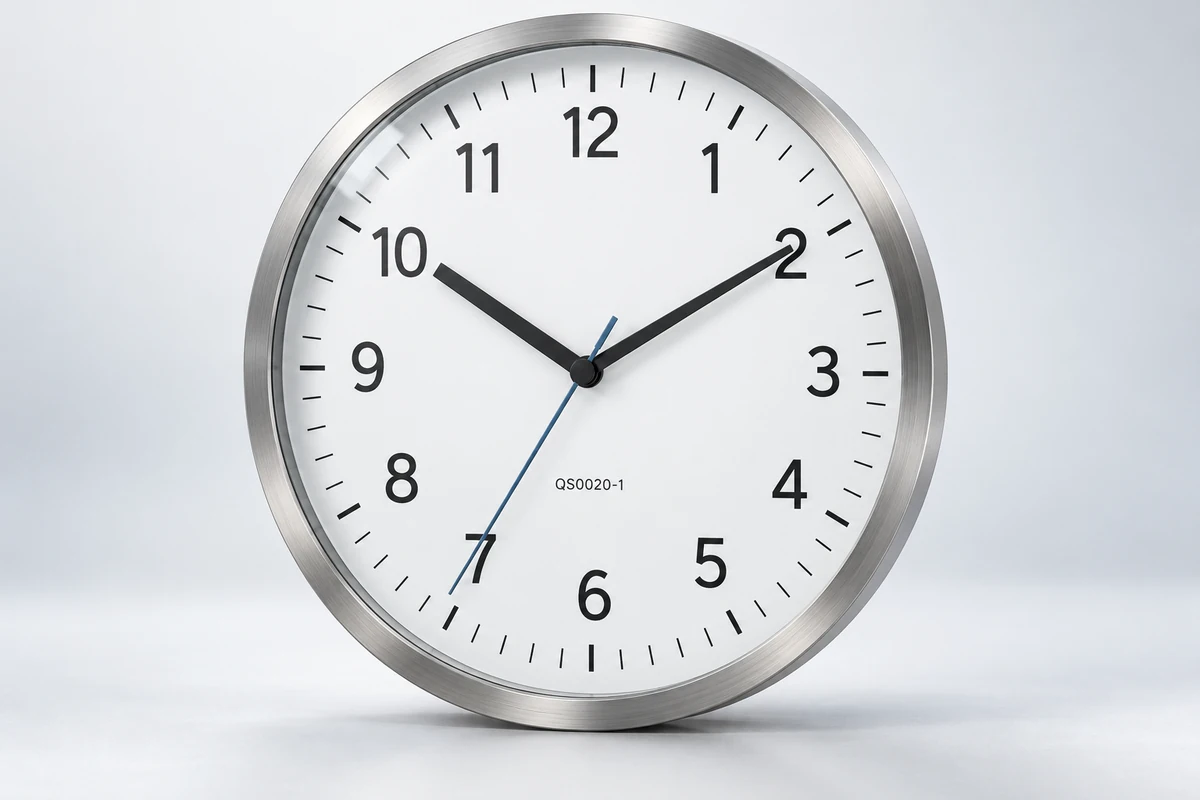
QS0020-1
Nineteen matching clocks provide the requested analog format, with a brushed stainless steel frame and glass front panel.
- Overall diameter400 mm
- DisplayHours, minutes and seconds
- Time inputNTP/SNTP through RJ45
- Power optionsPoE or approved external supply
How one master reaches all 19 clocks
-
Establish the master's reference
Select the approved reference input and confirm the required antenna and installation conditions.
-
Connect through the local network
Ethernet switches connect the master and the nineteen receiving clocks. Allow for clock connections, the master connection and infrastructure uplinks.
-
Assign the common NTP source
Configure each QS0020-1 with the master's reachable NTP server address and verify communication at all 19 positions.
The server's seven Ethernet interfaces do not limit this arrangement to seven clocks. The switching infrastructure provides the connections to the 19 displays; a dedicated server port is not required for each clock.
Plan the complete receiving-clock group
Clock power, network availability and the master's reference need to be considered together.
Maximum listed clock load
The QS0020-1 lists operating consumption of up to 15 W. For nineteen units, the combined device load is up to 285 W. This calculation is not a PoE switch rating: power losses, per-port capability, PoE compatibility and operating margin also need review.
The master has its own specified 220 V AC supplies. Clock power comes from suitable PoE equipment or the approved external power arrangement.
Define the continuity requirement
The master's temperature-compensated oscillator supports holdover during a temporary loss of the antenna reference, while the server remains powered and the LAN remains available.
A single master does not provide server redundancy. If automatic switchover to a second master is required, that equipment would be an addition to the requested package.
Keep the measurement points clear
These are equipment specifications, not measured results from the Peru site.
| Equipment | Specified value | Measurement |
|---|---|---|
| NTS-G-427001 | 0.5-5 ms | Typical NTP synchronization accuracy on a LAN. |
| QS0020-1 | ≤10 ms | Network synchronization accuracy. |
| QS0020-1 | ≤200 ms/day | Free-running accuracy while the clock remains powered. |
Network synchronization accuracy does not establish mechanical hand-positioning accuracy. Display alignment and correction behavior would be checked separately during acceptance.
Account for every clock, from C01 to C19
Suggested identifiers C01-C19 would link each unit to its location, IP address, master-server address and power connection.
- Master referenceConfirm the selected reference and normal operating status.
- All 19 connectionsVerify every clock communicates with the intended master.
- Local-time displayCheck Peru local time and the hand alignment on each clock.
- Recovery recordRecord behavior after agreed, controlled interruption tests.
Questions from project teams in Peru
Practical points for procurement, local installation and handover of this 1 + 19 configuration.
How should the clocks be set for Peru local time?
The required display time is Peru local time, UTC-5. The final configuration should identify the supported time-zone or offset setting for the supplied clock firmware and verify it on all 19 displays. The site team can compare the displayed time with INACAL's official Peru time service during commissioning.
Will the equipment work with a 220 V, 60 Hz supply in Peru?
Peru generally uses a 220 V, 60 Hz supply. The master-clock specification lists 220 V AC, while the analog clock lists an external adapter, a 12 V input and PoE support. The documents do not state the AC frequency range. Confirm the actual power-supply rating, local socket, grounding and any UPS connection before ordering; a matching voltage alone does not establish full compatibility.
Can the system operate without a public internet connection?
The proposed satellite-referenced arrangement can distribute time over the local network without a public internet time server, provided the satellite reference, antenna installation, power and LAN are suitable. All 19 clocks still need network access to the master. Any proposed 4G/5G reference option requires a separate compatibility review for the intended location and service in Peru.
Can we use the healthcare center's existing PoE switches?
Existing switches can be considered after checking the clock's exact PoE requirements, per-port capability and total power budget. Nineteen clocks represent up to 285 W of listed device load before power-delivery losses and design margin. The number of available network ports and the power budget both need to cover the proposed arrangement.
Are technical data sheets available in Spanish?
Yes. English and Spanish technical data sheets for the NTS-G-427001 and QS0020-1 are available in the PDF downloads at the top of this page. Each version contains the specifications for both models. State any additional Spanish-language installation or tender-document requirements in your enquiry.
What information is needed for delivery to Peru?
Provide the destination city, postal code, consignee details and preferred delivery arrangement. The quotation should identify the equipment package, production lead time, freight scope, delivery terms and responsibility for import clearance. Delivery to Lima or another destination, including any onward inland transport, should be agreed for the specific order.
Can HC Electronics support our local installer?
Include your installer's requirements when requesting the configuration. Remote assistance, working hours, support language, commissioning responsibilities and any on-site work should be confirmed in the project scope. Warranty coverage, replacement procedures and return-shipping responsibilities should also be recorded in the order terms.
Is the same configuration suitable for coastal, high-altitude or humid sites in Peru?
Location conditions need a separate review. Provide the installation altitude, indoor temperature, humidity, condensation risk and any coastal salt exposure. The QS0020-1 data sheet lists an operating temperature of -10 to 65 degrees C; it does not establish an altitude limit, humidity rating or ingress-protection rating. Suitability should be confirmed for the actual facility.
Plan your healthcare clock project with HC Electronics
Share your clock quantity, delivery city in Peru, network layout and power arrangements. We can review the master, receiving clocks and project scope together.