NTP vs GPS Clock: Which Fits Your Site?
An NTP clock is usually the practical starting point when an approved network time service already reaches the installation. A directly GPS-referenced clock becomes an alternative when network time is unavailable or unsuitable and a workable satellite antenna location is available.
The terms describe different parts of a timing system. NTP distributes time across an IP network; GPS can provide the reference behind that service. An NTP clock may therefore already be receiving GPS-derived time through a central server.
For procurement, the useful comparison is between a clock receiving time over the network and a clock using its own GPS receiving arrangement.
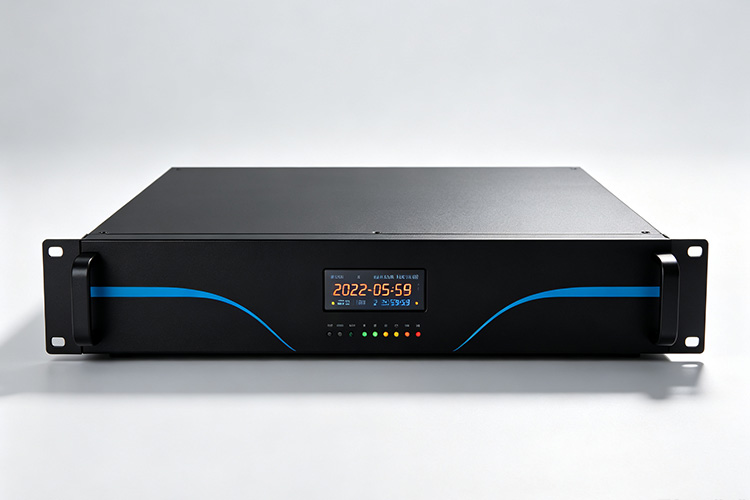
NTP vs Direct GPS: Decision Matrix
| Dimension | NTP Clock | Direct GPS-Referenced Clock |
|---|---|---|
| Accuracy | Depends on the server, network path and clock implementation. | Depends on reception, receiver implementation and how received time drives the display. |
| Infrastructure | Requires access to an NTP service through an IP network. | Requires a GPS receiver and suitable antenna arrangement. |
| Power | Separate supply or PoE, depending on the model. | Power is required for the display and receiving equipment. |
| Installation | Can use existing network infrastructure without an antenna at each display. | Must accommodate antenna placement and the approved connection to the receiver. |
| Maintenance | Involves the time service, network access and clock configuration. | Includes antenna, cable, reception status and receiver condition. |
| Network requirement | Needs a working route to the nominated NTP service; public internet is not inherently required. | Satellite reception itself does not require an IP network. |
| Retrofit suitability | Attractive where network access is already available at clock positions. | Attractive where an independent reference is needed and antenna access is practical. |
| Cost structure | Clock hardware, network connection, power and any additional time-service capacity. | Clock/receiver hardware, antenna installation, cable routing and protection. |
| Best-fit industry | Offices, education and other facilities with managed network time. | Isolated operational locations or facilities seeking a locally received satellite reference. |
| Typical topology | NTP server distributes time through the LAN to multiple clocks. | Satellite signals reach an antenna and receiver associated with the clock. |
Neither label guarantees a particular displayed-time tolerance. Measure the complete clock against the agreed reference when accuracy is a purchasing requirement. NTP performance also depends on the receiving implementation and communication path.
Choose NTP When the Network Is the Established Distribution Route
For a building with an approved internal time service, adding NTP displays can avoid creating separate satellite receiving installations.
The strongest case is a project with many indoor clocks and network connectivity already close to their intended positions. The infrastructure team can maintain the reference centrally, while each display uses the approved service.
A restricted internet policy does not automatically rule out NTP. An internal server can provide time over a private network.
Choose Direct GPS When Local Independence Has Clear Value
A directly referenced clock can be useful at a location that cannot depend on the building’s IP time service.
However, that independence has an installation cost. A clock in a basement, enclosed room or deeply sheltered position still needs a viable receiving arrangement. Moving reception to an external antenna may require a cable route that costs more than connecting the display to an existing LAN.
Evaluate the antenna location before treating direct GPS as the simpler option.
Consider GPS at the Server and NTP at the Displays
For multiple indoor clocks, a combined arrangement may offer the most practical division of responsibilities: a central GPS-referenced server establishes time, and the LAN distributes it to NTP displays.
This reduces the need for separate antennas at individual clock locations. It also means the displays depend on the server and network distribution path, even though the original reference comes from GPS.
Compare the Failure You Need to Tolerate
Network loss and satellite reception loss are different events.
For NTP, evaluate what happens when the nominated service becomes unreachable. For direct GPS, evaluate what happens when the receiver loses a valid reference. In either case, continued display operation depends on power, and timekeeping during reference loss depends on the clock’s oscillator and firmware.
Ask for a defined allowable drift over the interruption period that matters to your site.
Request an Architecture Comparison
Tell HC Electronics how many clock positions have network access, where an antenna could be installed and which service interruption the project must withstand.
Review NTP clock hardware or GPS synchronized clocks against the receiving arrangement selected for your site.
Compare NTP and GPS OptionsPublic vs local NTP servers for clocks
If an NTP distribution approach suits the site, the next decision is who operates its time service. Compare organization-owned, public and locally managed options without confusing server location with its reference source: Public vs local NTP servers for clocks.