Master Clock vs NTP Server: Which Does Your Installation Need?
Start with the equipment that must receive time.
A facility master clock is appropriate when retained receiving clocks need specific clock-control outputs. An NTP server is appropriate when the receiving devices obtain time through NTP over an IP network.
These roles can exist in the same appliance. The product name alone does not establish whether the required outputs are available.
This comparison uses “master clock” to mean a conventional facility clock controller, rather than a PTP grandmaster.
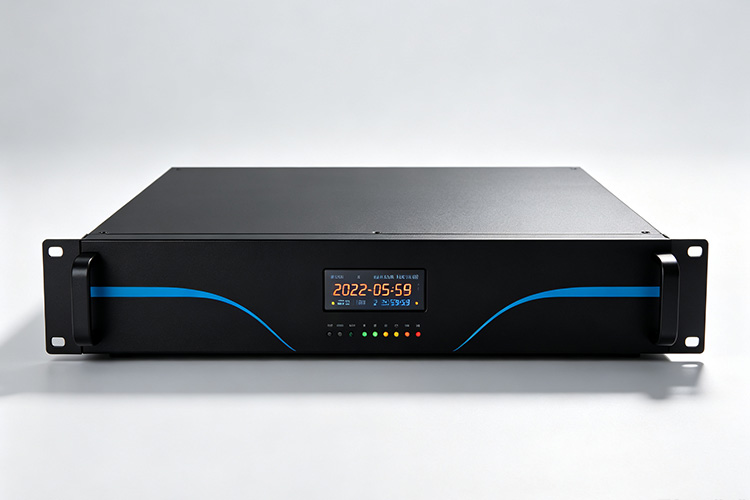
Master Clock vs NTP Server: Decision Matrix
| Dimension | Facility Master Clock | NTP Server |
|---|---|---|
| Accuracy | Depends on its reference, output timing and receiving clocks. | Depends on its reference, NTP implementation and the complete client path. |
| Infrastructure | Compatible clock circuits or dedicated distribution equipment. | IP network connecting the server to NTP-capable clients. |
| Power | Controller power plus the power arrangement required by receiving clocks. | Server power; client power is usually a separate infrastructure requirement. |
| Installation | Connect and configure the required clock outputs. | Establish network reachability and the intended time-service configuration. |
| Maintenance | Includes controller outputs, clock circuits and supported correction functions. | Includes time-service status, network access and appliance administration. |
| Network requirement | LAN access may be optional or used only for the reference or management. | IP connectivity is required for NTP service delivery. |
| Retrofit suitability | Useful when compatible conventional clocks and circuits will be retained. | Useful when the facility already has NTP clients or is moving to network time. |
| Cost structure | Controller, necessary output modules, distribution equipment and retained-circuit work. | Server, network integration and any replacement clients or required interfaces. |
| Best-fit industry | Established campuses and facilities with legacy clock infrastructure. | Networked facilities supporting clocks and other compatible IP devices. |
| Typical topology | Controller distributes timing through specified clock outputs. | Server answers time requests from clients across the network. |
Retaining Existing Clocks Usually Determines the First Choice
If the project must retain non-network receiving clocks, identify the signal they accept before selecting a replacement central unit.
An NTP server cannot directly operate a clock that requires an incompatible electrical signal. A suitable controller or interface may be required between the network time service and those displays.
Conversely, a controller with conventional clock outputs will not automatically serve NTP clients unless it also provides an NTP server function.
Separate Time Distribution from Other Controller Functions
Some installations use the central controller for more than distributing the current time.
If the existing equipment provides scheduled outputs, bell control or special clock-correction sequences, determine which functions the project still needs. NTP service alone does not replace them.
A replacement proposal should identify each retained function and the hardware responsible for it. This is especially important when removing an old controller that performs several roles.
Compare Three Migration Options
Retain the clock circuits and replace the controller
When it deserves considerationMost receiving clocks remain suitable and compatible output hardware is available.
Replace receiving clocks with NTP-capable units
When it deserves considerationNetwork access is practical and the project can absorb endpoint replacement.
Retain a compatible controller while introducing NTP distribution
When it deserves considerationDifferent areas need to migrate at different times.
The third option can spread replacement work across several phases. It can also add equipment and maintenance responsibilities, so compare the transitional cost with a complete replacement.
Avoid Buying Unneeded Interfaces
A multi-output appliance can be useful when both types of receiving equipment must operate together. It may add little value if only one interface is required.
Specify the active outputs, the equipment connected to each and any planned migration stage. This allows quotations to be compared by functional scope instead of the number of features listed.
Review Your Retained Equipment
Send HC Electronics a list of receiving-clock models, active controller outputs and any scheduled functions that must continue.
Review master clocks and NTP clock servers against the interfaces needed by your retained equipment.
Discuss a Master Clock or NTP Server Replacement