RS485 vs Ethernet Clock: Retain a Clock Bus or Use the LAN?
RS485 is worth evaluating when a compatible dedicated clock bus already exists or when several fixed displays can share a planned cable route. Ethernet is attractive when structured network cabling, switch capacity and IT support are available.
Neither interface defines the complete timing protocol. RS485 clocks must understand the controller’s data format, while Ethernet clocks must support the time service used on the network.
This comparison assumes an RS485 time-distribution bus and Ethernet clocks using NTP.
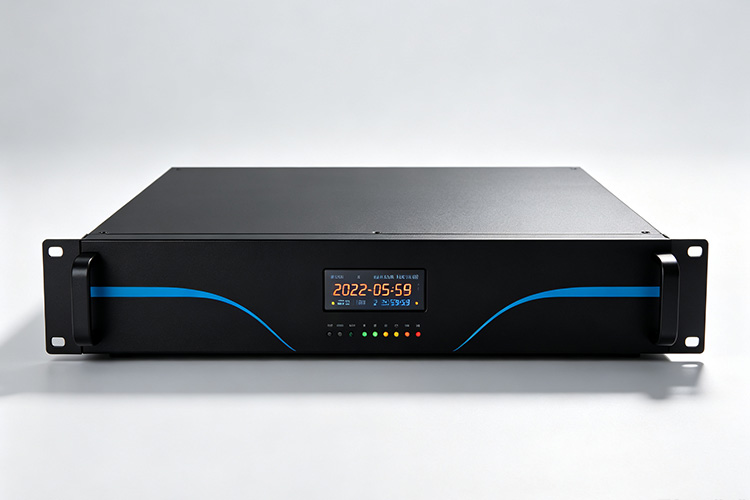
RS485 vs Ethernet: Decision Matrix
| Dimension | RS485 Clock Arrangement | Ethernet/NTP Clock Arrangement |
|---|---|---|
| Accuracy | Depends on the controller protocol, update timing and display implementation. | Depends on the NTP service, network conditions and client implementation. |
| Infrastructure | Compatible controller, suitable bus cabling and designed termination/protection. | Ethernet cabling, switches and an accessible NTP service. |
| Power | RS485 signaling does not itself specify clock power. | Separate supply or PoE where supported. |
| Installation | Requires a valid bus layout and correct electrical connections. | Usually uses individual clock links to switches. |
| Maintenance | May require tracing shared wiring and checking bus-level signals. | Can use switch/link diagnostics, supplemented by clock-specific monitoring. |
| Network Requirement | Receiving clocks do not inherently need IP addresses. | Requires approved network access and time-service reachability. |
| Retrofit Suitability | Strong where a documented, compatible bus can be retained. | Strong where Ethernet already reaches the required areas. |
| Cost Structure | Controller/interface, shared cable route, protection and bus testing. | Switch ports, cable drops, possible PoE capacity and network commissioning. |
| Best-Fit Industry | Fixed industrial or institutional installations with dedicated clock wiring. | Facilities managed around structured IP infrastructure. |
| Typical Topology | A designed multidrop bus, with segmentation or repeaters where required. | Switched star or hierarchical network, with a link to each clock. |
Existing Cable Is Valuable Only When It Fits the New Arrangement
Reusing RS485 infrastructure can reduce installation work, but the cable route and connected equipment must support the proposed system.
Confirm the controller’s message format and the receivers’ requirements. Two devices with RS485 terminals do not necessarily exchange compatible time information.
For Ethernet migration, existing twisted-pair cable should not automatically be treated as a usable network link. Its category, termination, route and condition must be assessed for the intended Ethernet installation.
Compare Shared Bus Wiring with Individual Network Links
A conventional RS485 design commonly uses a bus with controlled branch lengths and appropriate termination. Unplanned stars and long branches can create signal problems; the permitted layout depends on the transceivers, data rate and cable conditions.
A switched Ethernet installation generally gives each clock its own link to a switch. This can make a single damaged cable easier to isolate, while a switch or uplink failure may affect an entire group.
The useful comparison is the number of clocks affected by each likely fault and how quickly staff can locate it.
Include Maintenance Ownership in the Decision
An RS485 clock circuit may be maintained by the building-services or controls team. Ethernet clocks may involve IT for access policies, switch changes and network diagnostics.
Neither ownership model is inherently better. Problems arise when the chosen infrastructure has no clearly assigned support team.
Before approval, identify who can restore service after a controller failure, cable fault or configuration change.
Do Not Assume an Adapter Completes the Migration
A generic serial-to-Ethernet adapter may transport data without converting it into the time protocol the receiving clocks need.
Any gateway must be assessed for the actual source protocol, destination protocol and required timing behavior. Include its power, maintenance and failure impact in the comparison.
For a large migration, compare gateway-based retention against replacing the affected endpoints.
Price the Next Group of Clocks
Ask how each option would add a realistic future group: another corridor, production area or building.
RS485 expansion may require segmentation and additional interfaces. Ethernet expansion may require more ports, another switch or new network routes. Include those costs before selecting the initial architecture.
Discuss RS485 and Ethernet Clock Options with HC Electronics
Share your existing clock wiring, controller details and network plan to compare retention and migration options.
For deployment details, review wired clock system planning and NTP network clock systems.
Contact HC ElectronicsContact us via WhatsApp