Wireless vs Wired Clock System
A dedicated wireless clock system can reduce timing-cable installation in an occupied building. A wired clock system can be attractive where suitable routes already exist or where the facility prefers a physically defined distribution path.
The decision is a trade-off between radio coverage and cable infrastructure, together with the cost of maintaining each over time.
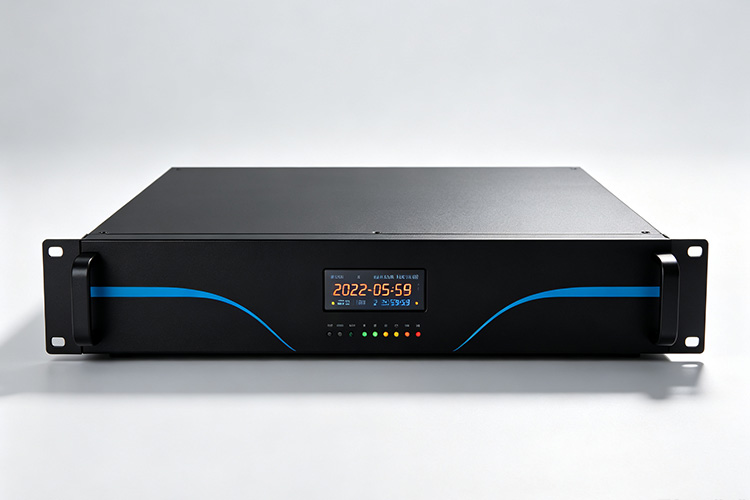
Here, wireless refers to a dedicated radio transmitter-and-receiver clock arrangement. Wired refers to dedicated clock circuits, such as a compatible RS485-based arrangement. For clocks connected through the building’s LAN, see PoE vs Wi-Fi Clock.
Wireless vs Wired: Decision Matrix
01| Dimension | Dedicated Wireless System | Dedicated Wired System |
|---|---|---|
| Accuracy | Depends on reference quality, radio update behavior and receiver timekeeping. | Depends on reference quality, signaling method and receiving-clock implementation. |
| Infrastructure | Transmitting equipment and verified reception at clock positions. | Compatible controller, suitable timing cables and any required distribution components. |
| Power | Transmitter and clocks need their specified power supplies. | Power may be separate or incorporated in the selected clock arrangement. |
| Installation | Reduces timing-cable routes but requires coverage verification. | Requires cable installation or verification of retained circuits. |
| Maintenance | Focuses on reception, transmitting equipment and clock power. | Focuses on circuit condition, connections, interfaces and power distribution. |
| Network requirement | Receiving clocks may operate without LAN connections; the transmitter’s reference may still use a network. | Dedicated clock circuits may operate without LAN access; the controller’s reference may still use one. |
| Retrofit suitability | Attractive where opening walls or ceilings is difficult. | Attractive where existing wiring is serviceable and electrically compatible. |
| Cost structure | Transmitter, receivers, coverage assessment and supported extension equipment if needed. | Controller, cables, distribution components, installation labor and circuit testing. |
| Best-fit industry | Occupied education, office and heritage-building projects with verified reception. | Fixed institutional or industrial installations with accessible cable infrastructure. |
| Typical topology | A transmitter serves receivers within its validated coverage area. | A controller serves clocks through documented circuits or bus segments. |
When Wireless Has the Stronger Case
Wireless is worth evaluating when the cost or disruption of running timing cables dominates the project.
Examples include completed classrooms, occupied offices and buildings where decorative finishes restrict access. The advantage is strongest when power is already available at the display positions.
The decision should depend on demonstrated reception in representative locations. Reinforced structures, metalwork and later changes to partitions or equipment can alter the result.
When Wired Has the Stronger Case
Wired distribution is attractive when installation routes are already open or a usable clock circuit can be retained.
A dedicated cable arrangement can also suit maintenance teams that prefer to diagnose defined circuits and connections. However, its reliability depends on correct installation and the condition of the entire path.
A damaged shared circuit can affect several clocks. A large wireless coverage area may likewise depend on one transmitter. Compare the extent of a failure, not simply whether the system uses cable.
Compare Expansion at the Most Difficult Location
The next clock may be installed beyond the original coverage area or at the end of an already loaded circuit.
For wireless expansion, assess reception and compatibility at the new position. For wired expansion, assess the circuit’s electrical capacity, topology and available power.
Ask each supplier to price a realistic future addition. This exposes costs that an initial equipment quotation may hide.
Use a Hybrid Where Building Conditions Differ
One solution does not need to cover every location.
A campus may retain wired clocks in an existing wing while using a dedicated wireless arrangement in a refurbished building. The sections can reference a common source where compatible equipment supports that design.
The proposal should identify the boundary between the two arrangements and how their displayed-time agreement will be checked.
Make the Decision with a Site-Based Trial
Compare a difficult radio reception point against a difficult cable route. Record installation effort, synchronization behavior and recovery after a controlled interruption.
Send HC Electronics the retained wiring information, proposed wireless areas and expected expansion locations.
Review wireless clock systems and wired clock systems against the actual coverage and cable-route findings.
Compare Wired and Wireless Project Options